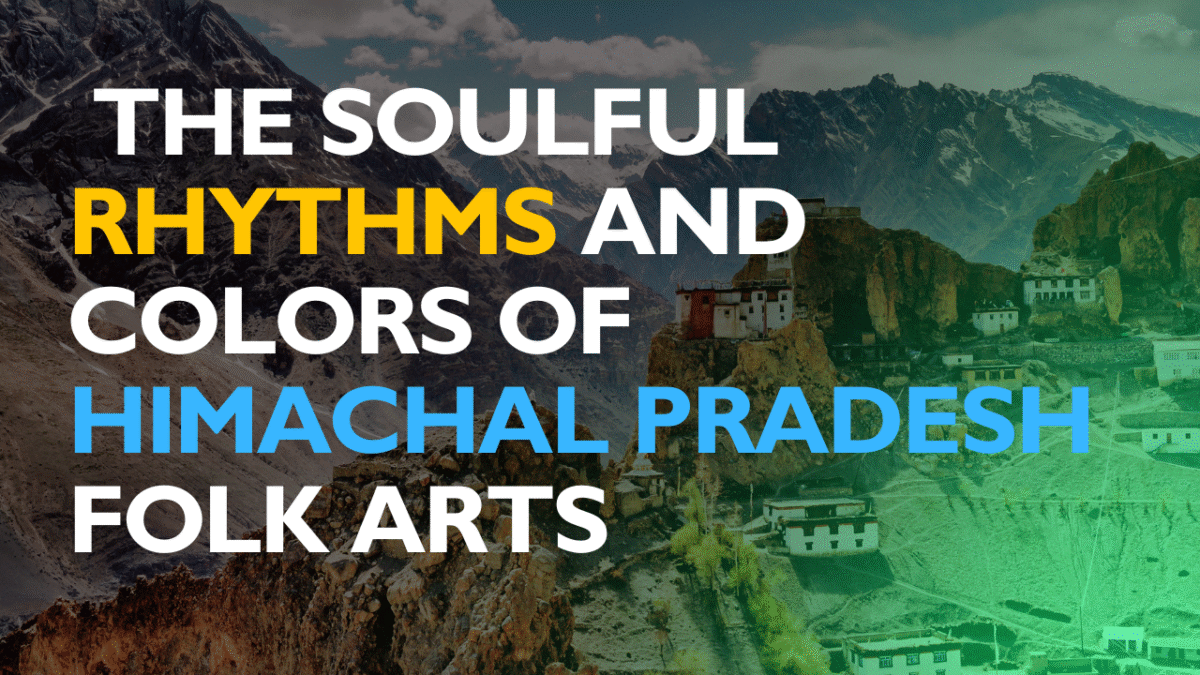
The Soulful Rhythms and Colors of Himachal Pradesh: Folk Arts

 The Soulful Rhythms and Colors of Himachal Pradesh: Folk Arts Nestled in the majestic Himalayas, Himachal Pradesh, often called the “Land of Gods,” is not only blessed with breathtaking natural beauty but also a rich and vibrant cultural heritage. The heart of this heritage beats in its diverse folk arts – the energetic dances that tell tales of yore, the soulful songs that echo through the valleys, the captivating dramas that bring legends to life, the melodious instruments that fill the air, and the talented folk artists who keep these traditions alive. These art forms are not mere entertainment; they are the threads that weave together the social, religious, and historical fabric of the Himachali people.   

  1. The Vibrant Tapestry of Himachal’s Folk Arts: Briefly introduces Himachal Pradesh and its rich cultural heritage.

    Highlight the significance of folk dance, song, drama, music, and artists in the state’s identity.

    Emphasize the connection between these art forms and the daily life, traditions, and natural beauty of the region.

    2. The Enchanting Rhythms: Exploring the Folk Dances of Himachal Pradesh

    Introduction to Himachal’s Folk Dances: Discuss the diversity and regional variations in dance forms.

    • Key Folk Dances:
      • Nati: The quintessential folk dance of Himachal. Its various forms across different districts (Kullu Nati, Sirmouri Nati, Kinnauri Nati, etc.). The social significance of Nati, occasions for performance, characteristic movements, and costumes.  
      • Giddha: A lively and energetic dance predominantly performed by women, especially in the Kangra region. Its themes, rhythmic clapping, and circular formations.  
      • Dhamal: A powerful and energetic dance, often associated with religious festivals and performed by men. The use of drums and other instruments, vigorous movements, and storytelling aspects.
      • Chham: Masked dances prevalent in the Buddhist regions of Lahaul and Spiti. Their religious significance, elaborate costumes, and portrayal of deities and demons. Different types of Cham dances.  
      • Jhoori: A slow and graceful dance, often performed by women during social gatherings and fairs. Its lyrical movements and expressions of love and longing.  
      • Other Notable Dances: Introduce other regional or less common dances like Kayang, Bakayang, Shand, Thoda (with its martial arts elements), etc., briefly describing their unique features.  
    • Costumes and Significance: Discuss the traditional attire worn during folk dances and their symbolic meaning.
    • Preservation Efforts: Briefly touch upon the importance of preserving these dance forms.

    3. The Melodious Voices: Unveiling the Folk Songs of Himachal Pradesh

    • Introduction to Himachal’s Folk Songs: Discuss the role of folk songs in storytelling, celebrating festivals, and expressing emotions. The connection between songs and daily life.
    • Types of Folk Songs:
      • Love Songs: Explore the themes of romance, separation, and longing in songs like Mohana, Jhukru, etc.  
      • Festival Songs: Discuss songs associated with various festivals like Dussehra, Diwali, Shivaratri, and local fairs. Their celebratory nature and religious significance.
      • Work Songs: Songs sung during agricultural activities, construction, and other forms of labor, reflecting the rhythm of work and community spirit.
      • Ballads and Epic Songs: Explore narrative songs that recount historical events, heroic tales, and local legends.
      • Ritualistic Songs: Songs sung during specific ceremonies and rituals, often with religious or spiritual connotations.
      • Children’s Songs: Traditional rhymes and songs passed down through generations.
    • Regional Variations: Highlight how the dialect and themes of folk songs vary across different regions of Himachal (e.g., Kangra, Kullu, Shimla, Kinnaur).
    • The Role of Language: Discuss the importance of local dialects in preserving the authenticity of folk songs.
    • Modern Influences and Preservation: Briefly discuss the impact of modern music and efforts to keep traditional folk songs alive.

    4. The Dramatic Narratives: Exploring the Folk Dramas of Himachal Pradesh 

    Introduction to Himachal’s Folk Drama: Discuss the traditional forms of theatrical performances in the state, often blending music, dance, and storytelling.  The Soulful Rhythms and Colors of Himachal Pradesh: Folk Arts.

    Key Folk Drama Forms:

    • Kariyala: A traditional form of folk theatre prevalent in the Shimla and Sirmaur regions. Its satirical and humorous nature, social commentary, and use of stock characters.  
    • Bhagat: A religious form of folk drama, often depicting stories from Hindu epics and Puranas. Its devotional aspect and community involvement.
    • Swang: A popular form of folk theatre with elements of mimicry, comedy, and social satire. Its improvisational nature and entertainment value.
    • Ramleela and Krishnaleela: Traditional enactments of the Ramayana and Mahabharata, often performed during festivals. Their cultural and religious significance.
    • Performance Elements: Discuss the costumes, dialogues, and stagecraft involved in these folk dramas.
    • Evolution and Challenges: Briefly touch upon the changing landscape of folk theatre and the challenges it faces in the modern era.

    5. The Soulful Sounds: Musical Instruments of Himachal Pradesh 

    Introduction to Himachali Musical Instruments: Discuss the diverse range of traditional instruments used in folk music and dance. Their connection to the natural environment and local craftsmanship.  The Soulful Rhythms and Colors of Himachal Pradesh: Folk Arts.

    Categories of Instruments:

    Percussion Instruments:

    • Dhol: A large barrel-shaped drum, fundamental to many folk performances. Its variations and rhythmic patterns.  
    • Nagara: A set of kettledrums, often played in pairs, associated with religious ceremonies and festivals.  
    • Damangaru: A small, double-headed drum played by twisting the wrist, often used in ritualistic contexts.
    • Dholki: A smaller version of the dhol, popular in various folk dances.
    • Wind Instruments:
      • Shehnai: An oboe-like instrument, often played during auspicious occasions.  
      • Algoza: A double flute played simultaneously, producing a unique melody.  
      • Pungi/Been: A wind instrument traditionally associated with snake charmers, but also found in some folk music forms.  
      • Karnal: A long, straight brass trumpet, used for ceremonial purposes.  
      • Flutes (Bansuri): Simple bamboo flutes, popular for lyrical melodies.
    • Stringed Instruments:
      • Rabab: A lute-like instrument with a resonant sound.  
      • Sarangi: A bowed string instrument, often used to accompany vocal music.  
      • Kindari: A single-stringed instrument, sometimes used by wandering minstrels.
    • Construction and Materials: Briefly discuss the traditional materials used to make these instruments.
    • The Role of Instruments in Performances: Explain how different instruments contribute to the overall sound and rhythm of folk music and dance.

    6. The Custodians of Culture: The Folk Artists of Himachal Pradesh

    • Introduction to Himachali Folk Artists: Highlight the crucial role of individual artists and communities in preserving and propagating these art forms.
    • Traditional Roles and Social Status: Discuss the traditional social standing of folk artists and their contribution to community life.
    • Master Performers and (Transmission): Feature the stories and contributions of renowned folk artists (if specific names are widely recognized). Emphasize the importance of the guru-shishya parampara (teacher-student tradition) in passing down knowledge and skills.
    • Challenges Faced by Folk Artists: Discuss the economic and social challenges faced by traditional artists in the modern world.
    • Efforts to Support Folk Artists: Highlight government and non-governmental initiatives aimed at promoting and supporting folk artists and their art forms.
    • The Future of Folk Artistry: Discuss the importance of encouraging young generations to embrace these traditions.

    7. Connecting with the Roots: Experiencing the Folk Arts of Himachal Pradesh

    • Suggest ways for tourists and locals to experience these art forms (e.g., attending festivals, visiting cultural centers, watching performances).
    • Emphasize the immersive and enriching experience of witnessing these traditions firsthand.
    • Encourage respect for the artists and their cultural heritage.

    8. Conclusion: The Enduring Legacy of Himachal’s Folk Arts

    • Summarize the richness and diversity of Himachal’s folk dance, song, drama, music, and the dedication of its artists.
    • Reiterate the importance of preserving these traditions for future generations.
    • End with a powerful statement about the cultural significance of these art forms to the identity of Himachal Pradesh.

    SSC CGL Exam Guide: Everything You Need to Know to Succeed

    SSC CGL Exam Guide: Everything You Need to Know to Succeed : The Staff Selection Commission Combined Graduate Level (SSC CGL) exam is one of the most popular government exams in India. Every year, lakhs of candidates appear for it with the dream of securing a stable government job. If you are planning to appear for SSC CGL, then you are in the right place. This guide will walk you through every important detail about the exam, from eligibility to preparation tips.

    What is SSC CGL?

    SSC CGL is conducted by the Staff Selection Commission to recruit staff for various Group B and Group C posts in ministries, departments, and organizations of the Government of India. These jobs offer good salary packages, job security, and other benefits, making them highly attractive to job seekers.

    Eligibility Criteria

    Before applying, make sure you meet the eligibility criteria. Here are the main points:
    Nationality: You must be an Indian citizen.

    Age Limit: Age varies according to the post. Generally, it’s between 18 to 32 years. Age relaxation is provided for reserved categories.

    Educational Qualification: A Bachelor’s degree in any discipline from a recognized university.

    SSC CGL Exam Pattern

    The exam is conducted in four tiers:

    tier I – Preliminary Exam
    • Objective type
    • Sections: General Intelligence & Reasoning, General Awareness, Quantitative Aptitude, English Comprehension
    • Duration: 60 minutes
    Tier II – Main exam
    • Objective type
    • Papers: Quantitative Abilities, English Language and Comprehension, Statistics (for some posts), General Studies (Finance & Economics – for some posts)
    • Duration: 120 minutes for each paper
    tier III – Descriptive Paper
    • Pen and paper mode
    • Essay, Letter, Application writing in English or Hindi
    • Duration: 60 minutes
    Tier IV – Skill Test/Computer Proficiency Test (CPT)/Document Verification
    • Depends on the post applied for

    Application Process

    The application process is completely online. Here are the steps:

    1. Visit the official SSC website (https://ssc.nic.in)
    2. Register yourself with basic details
    3. Fill in the application form
    4. Upload required documents and photograph
    5. Pay the application fee
    6. Submit and take a printout of the confirmation

    Syllabus Overview

    Here’s a quick overview of the important topics:

    General Intelligence and Reasoning: Analogies, Coding-Decoding, Series, Puzzles

    General Awareness: Current Affairs, Indian History, Geography, Polity, Economics, Static GK

    Quantitative Aptitude: Algebra, Geometry, Trigonometry, Mensuration, Data Interpretation

    English Comprehension: Grammar, Vocabulary, Reading Comprehension, Cloze Test

    Preparation Tips

    1. Understand the Syllabus and Pattern: First of all, get familiar with the syllabus and exam pattern.
    2. Make a Study Plan: Divide your time equally among subjects. Focus more on weak areas.
    3. Practice Regularly: Solve previous years’ papers and take mock tests.
    4. Read Daily: Keep up with current affairs. Read newspapers or follow news apps.
    5. Focus on Time Management: Time is crucial in exams. Practice solving questions within time limits.
    6. Revise Frequently: Regular revision is key to remembering concepts.
    7. Stay Motivated and Healthy: Don’t burn out. Take breaks and eat healthy.

    Best Books for SSC CGL Preparation

    • Quantitative Aptitude: R.S. Aggarwal, Arun Sharma
    • English: Wren and Martin, Plinth to Paramount
    • Reasoning: R.S. Aggarwal, Kiran Publication
    • General Awareness: Lucent’s GK, Current Affairs magazines

    Important Dates

    SSC releases its exam calendar every year. Keep checking the official website for updates on:

    • Application Start and End Dates
    • Admit Card Release
    • Exam Dates for Tiers I to IV
    • Result Dates

    Common Mistakes to Avoid

    • Ignoring the syllabus and studying randomly
    • Not giving enough time to revision
    • Overloading with too many books
    • Not attempting mock tests
    • Ignoring descriptive and skill test preparation

    What Happens After the Exam?

    After each tier, SSC releases results and cut-offs. If you clear all tiers and meet the cut-off, you move to document verification and final selection.

    Career Opportunities and Salary

    Posts under SSC CGL include:

    • Income Tax Inspector
    • Assistant Section Officer
    • Central Excise Inspector
    • Sub-Inspector (CBI)
    • Auditor

    Salary varies by post but usually ranges from Rs. 35,000 to Rs. 70,000 per month with various allowances.

    Final Thoughts

    The SSC CGL exam can open doors to a secure and prestigious career in the government sector. Yes, the competition is tough, but with the right preparation, discipline, and mindset, success is absolutely achievable. Start your preparation today and stay consistent. Good luck!

    Climate and Climatic Zones in Himachal Pradesh

    The climate of Himachal Pradesh is primarily influenced by its mountainous terrain and altitude, which varies from about 350 meters to 6,975 meters above sea level. The state experiences a typical Himalayan climate, characterized by significant variations in temperature and precipitation depending on the elevation and aspect. Climate and Climatic Zones in Himachal Pradesh Generally, the year can be divided into four main seasons:

    • Winter (December to February): Cold, with snowfall at higher altitudes and frost in lower regions.
    • Spring (March to April): Pleasant and comfortable, with gradually rising temperatures and blooming vegetation.  
    • Summer (May to June): Mild in the upper hills and warm to hot in the lower valleys.
    • Monsoon (July to September): Characterized by heavy rainfall, especially in the southern parts of the state, which can lead to erosion, floods, and landslides.
    • Autumn (October to November): Clear skies and pleasant temperatures as the monsoon recedes.  

    Himachal Pradesh can be broadly divided into four major climatic zones based on altitude:

    1. Sub-Humid Tropical (450-900 meters): Found in the southern low tracts.
    2. Warm and Temperate (900-1800 meters): Located in the mid-hills.
    3. Cool and Temperate (1800-2400 meters): Present in the higher hills.
    4. Cold Glacial and Alpine (2400-4800 meters and above): Found in the northern and eastern high-altitude mountains.

    1. Kangra District:

    • Location: Western part of Himachal Pradesh, encompassing the southern low hills rising to the mid-hills.
    • Altitude: Ranges from 430 to 6600 meters above sea level.
    • Climate: Exhibits a significant variation from sub-humid tropical in the lower regions (like Nurpur and Indora) to warm and temperate in the mid-hills (like Dharamshala and Palampur) and cool and temperate at higher elevations.
    • Temperature: Summer temperatures in the lower areas can reach up to 35°C, while the mid-hills experience milder summers (20-30°C). Winters are cold, with the possibility of frost in the lower regions and snowfall in the higher reaches, especially around Dharamshala and Palampur.
    • Rainfall: Receives the highest rainfall in the state, with Dharamshala being one of the wettest places in India, receiving an average of around 3400 mm annually. The monsoon season (July-August) is particularly heavy. The southern parts also receive substantial rainfall.
    • Climatic Zones: Primarily falls under the sub-humid subtropical and wet temperate zones.
    • Agriculture: The lower regions are suitable for cultivating maize, wheat, paddy, sugarcane, and citrus fruits. The mid-hills are known for tea plantations (around Palampur), potatoes, vegetables, and temperate fruits.

    2. Mandi District:

    • Location: Central part of Himachal Pradesh, characterized by valleys and hills.
    • Altitude: Varies from 670 to 3720 meters above sea level.
    • Climate: Ranges from warm and temperate in the lower parts (like Sundernagar and Jogindernagar) to cool and temperate in the higher regions (like Karsog and Chachyot).
    • Temperature: Summers in the lower valleys are warm (25-35°C), while the higher hills have pleasant summers (18-28°C). Winters are cold, with frost in the valleys and snowfall in the higher hills.  
    • Rainfall: Receives moderate to heavy rainfall, with the monsoon being the wettest period. The average annual rainfall varies between 1000 to 2000 mm.
    • Climatic Zones: Primarily covers the humid subtropical and humid temperate zones.
    • Agriculture: The district is diverse, with cultivation of wheat, maize, paddy in the lower areas, and temperate fruits, potatoes, and vegetables in the mid and higher hills. It is also known for horticulture.

    3. Hamirpur District:

    • Location: Lower hills of Himachal Pradesh, part of the sub-Himalayan zone.
    • Altitude: Generally ranges from 400 to 1100 meters above sea level.
    • Climate: Primarily humid subtropical, with hot summers and mild winters.
    • Temperature: Summers are hot, with temperatures often exceeding 35°C. Winters are mild, with temperatures ranging from 5°C to 15°C. Frost is common during winter nights.
    • Rainfall: Receives moderate rainfall, with the majority occurring during the monsoon season. The average annual rainfall is around 1200-1500 mm.
    • Climatic Zones: Predominantly falls under the humid subtropical zone.
    • Agriculture: Primarily rain-fed agriculture, with major crops including wheat, maize, and oilseeds. Horticulture is also practiced on a smaller scale.

    4. Bilaspur District:

    • Location: Lower hills of Himachal Pradesh, bordering Punjab.
    • Altitude: Ranges from 400 to 1400 meters above sea level.
    • Climate: Humid subtropical, similar to Hamirpur, with hot summers and mild winters.
    • Temperature: Summers are hot, with temperatures potentially reaching 40°C. Winters are mild, with temperatures ranging from 5°C to 18°C.  
    • Rainfall: Receives moderate rainfall, concentrated during the monsoon season. The average annual rainfall is between 1000 to 1400 mm.
    • Climatic Zones: Primarily in the humid subtropical zone.
    • Agriculture: Major crops include wheat, maize, paddy, and sugarcane. Citrus fruits are also grown in some areas.  

    5. Una District:

    • Location: Southernmost district of Himachal Pradesh, in the low-lying foothills.
    • Altitude: Ranges from 350 to 1200 meters above sea level.
    • Climate: Sub-humid subtropical, with hot and dry summers and mild winters.
    • Temperature: Experiences the hottest summers in the state, with temperatures often crossing 40°C. Winters are mild, with temperatures ranging from 5°C to 20°C.
    • Rainfall: Receives relatively lower rainfall compared to other districts, with an average of 1000-1200 mm annually, mostly during the monsoon.
    • Climatic Zones: Predominantly sub-humid subtropical.
    • Agriculture: Known for wheat, maize, oilseeds, and vegetables. Horticulture, especially citrus fruits, is also significant.  

    6. Solan District:

    • Location: Southern Himachal Pradesh, characterized by hills and valleys.
    • Altitude: Varies from 300 to 3000 meters above sea level.
    • Climate: Exhibits range from sub-humid subtropical in the lower parts (like Nalagarh) to warm and temperate and cool and temperate in the higher elevations (like Solan and Kasauli).
    • Temperature: Summers in the lower areas are warm (30-35°C), while the mid and higher hills have pleasant summers (20-30°C). Winters are cold, with frost in the lower regions and snowfall in the higher hills.  
    • Rainfall: Receives moderate to heavy rainfall, with the monsoon being the main rainy season. The average annual rainfall ranges from 1000 to 1500 mm.
    • Climatic Zones: Covers sub-humid subtropical and humid temperate zones.
    • Agriculture: Diverse agricultural practices, with wheat, maize, vegetables, and fruits like apples, peaches, and plums being grown. It is also a significant industrial hub.

    7. Sirmaur District:

    • Location: Southeastern part of Himachal Pradesh, bordering Uttarakhand.
    • Altitude: Ranges from 350 to 4500 meters above sea level.
    • Climate: Varies from sub-humid subtropical in the lower regions (like Paonta Sahib) to warm and temperate and cool and temperate in the mid and higher hills (like Nahan and Churdhar).
    • Temperature: Similar to Solan, with hot summers in the lower areas and mild summers in the higher hills. Winters are cold, with frost in the valleys and snowfall at higher altitudes.  
    • Rainfall: Receives moderate to heavy rainfall, with the monsoon being the wettest period. The average annual rainfall is between 1000 to 2000 mm.
    • Climatic Zones: Includes sub-humid subtropical and humid temperate zones.
    • Agriculture: Diverse agriculture, with wheat, maize, sugarcane, and fruits like mangoes and citrus in the lower areas, and temperate fruits and vegetables in the higher hills.

    8. Shimla District:

    • Altitude: Ranges from 900 to 6000 meters above sea level.
    • Climate: Predominantly warm and temperate and cool and temperate, with higher reaches experiencing cold glacial and alpine conditions.
    • Temperature: Summers are pleasant (15-25°C), while winters are cold, with frequent snowfall, especially in areas like Kufri, Narkanda, and Chanshal. Temperatures can drop below freezing point during winter.  
    • Rainfall: Receives moderate rainfall, with the monsoon and winter precipitation (snow) being important. The average annual rainfall is around 1000-1500 mm.
    • Climatic Zones: Primarily humid temperate and sub-humid temperate alpine highlands.
    • Agriculture: Known for horticulture, especially apple cultivation, along with other temperate fruits like pears, cherries, and plums. Vegetables are also grown. 

    9. Kullu District:

    • Location: Central Himachal Pradesh, known for its valleys and high mountains.
    • Altitude: Varies from 1000 to 6000 meters above sea level.
    • Climate: Ranges from warm and temperate in the lower valleys (like Kullu town) to cool and temperate in the mid-hills (like Manali) and cold glacial and alpine in the higher reaches.
    • Temperature: Summers are mild (20-30°C) in the valleys and cooler at higher altitudes. Winters are cold, with snowfall common, especially in Manali and beyond.  
    • Rainfall: Receives moderate rainfall, with the monsoon and winter snowfall contributing significantly. The average annual rainfall is around 1000-1400 mm.
    • Climatic Zones: Primarily humid temperate and sub-humid temperate alpine highlands.
    • Agriculture: Famous for apple orchards, along with other temperate fruits like pears, plums, and apricots. Vegetables and some cereals are also cultivated.  

    10. Chamba District:

    • Location: Northwestern part of Himachal Pradesh, with diverse topography.
    • Altitude: Ranges from 600 to 5800 meters above sea level.
    • Climate: Varies significantly from warm and temperate in the lower areas to cool and temperate and cold glacial and alpine in the higher mountains (like Pangi and Dalhousie).
    • Temperature: Summers in the lower valleys are warm (25-35°C), while the higher hills have pleasant summers (15-25°C). Winters are cold, with widespread snowfall in the higher regions.  
    • Rainfall: Receives moderate to heavy rainfall, with Dharamshala’s influence extending to the southern parts. The higher northern regions like Pangi are drier and receive snowfall. The average annual rainfall varies greatly across the district.
    • Climatic Zones: Covers humid subtropical, humid temperate, and sub-humid temperate alpine highlands.
    • Agriculture: Diverse, with maize, wheat, and paddy in the lower areas, and temperate fruits, potatoes, and dry fruits in the higher regions.

    11. Lahaul and Spiti District:

    • Location: Northernmost and easternmost part of Himachal Pradesh, forming a cold desert region.  
    • Altitude: Ranges from 2700 to 6500 meters above sea level.
    • Climate: Cold and arid (frigid arid zone), with long, harsh winters and short, cool summers.
    • Temperature: Experiences extreme temperature variations. Summers are mild with daytime temperatures ranging from 15°C to 25°C, but nights are cold (around 0°C). Winters are severely cold, with temperatures dropping to -15°C or even lower.
    • Rainfall: Receives the lowest rainfall in the state (below 200 mm annually), as it lies in the rain shadow of the Greater Himalayas. Precipitation is mostly in the form of snow during winter.
    • Climatic Zones: Primarily sub-humid temperate alpine highlands and frigid arid zone.
    • Agriculture: Limited due to the harsh climate and short growing season. Main crops include barley, buckwheat, potatoes, and some vegetables. Dry fruits are also cultivated.

    12. Kinnaur District:

    • Location: Eastern part of Himachal Pradesh, bordering Tibet, characterized by high mountains and valleys along the Sutlej River.
    • Altitude: Ranges from 2320 to 6800 meters above sea level.
    • Climate: Varies from cool and temperate in the lower valleys to cold and arid (sub-humid temperate alpine highlands and frigid arid zone) in the higher regions.
    • Temperature: Summers are cool (15-25°C), while winters are very cold with heavy snowfall in the upper areas. The lower valleys experience relatively milder winters.  
    • Rainfall: Generally receives low rainfall, as it also lies in the rain shadow. Precipitation is mainly in the form of snow, especially at higher altitudes. The lower Sutlej valley receives slightly more rainfall.Climate and Climatic Zones in Himachal Pradesh.
    • Climatic Zones: Primarily sub-humid temperate alpine highlands and frigid arid zone.
    • Agriculture: Known for its high-quality apples, along with other dry fruits like almonds, walnuts, and apricots. Barley and buckwheat are also grown.

    Impact of Altitude on Climate:

    The most significant factor influencing the climate of Himachal Pradesh is altitude. As elevation increases:
    Temperature decreases: Generally, temperature drops by about 6.5°C for every 1000 meters increase in altitude.

    Precipitation patterns change: Higher altitudes tend to receive more snowfall, while the lower regions receive more rainfall during the monsoon.

    Vegetation zones change: Corresponding to the temperature and moisture gradients, different types of forests and vegetation thrive at various altitudes.

    Agro-Climatic Zones:

    For agricultural planning, Himachal Pradesh is often divided into four main agro-climatic zones:

    1. Low Hill and Valley Areas (Subtropical): (365-914 meters) – Includes parts of Kangra, Hamirpur, Una, Bilaspur, lower Mandi, Solan, and Sirmaur. Suitable for mango, litchi, citrus, and low-chilling varieties of stone fruits.  
    2. Mid Hills (Sub-Temperate): (915-1523 meters) – Covers parts of Mandi, Solan, Sirmaur, Kullu, Kangra, and Shimla. Ideal for stone fruits (peach, plum, apricot), pear, walnut, and kiwi. Climate and Climatic Zones in Himachal Pradesh.
    3. High Hills and Valleys (Temperate): (1524-2742 meters) – Includes upper parts of Shimla, Kullu, Kangra, and Chamba. Best suited for apple, pear, cherry, almond, and walnut.
    4. Cold and Dry Zone (Dry Temperate): (2743-3656 meters) – Comprises Lahaul-Spiti and parts of Kinnaur and Chamba. Suitable for apple, grapes, apricot (drying type), and almond.

    Climate Change Impacts:

    Himachal Pradesh is highly vulnerable to the impacts of climate change. Observed changes include:

    • Decreasing snowfall: Reduced winter snowfall is affecting the water supply for agriculture and hydropower.
    • Erratic rainfall patterns: Increased frequency of extreme rainfall events leading to floods and landslides, and prolonged dry spells affecting agriculture. Climate and Climatic Zones in Himachal Pradesh.  
    • Rising temperatures: Affecting the cultivation of traditional crops like apples, forcing farmers to shift to higher altitudes or other crops.  
    • Glacier melt: Accelerated melting of glaciers is impacting river flows and long-term water security.
    • Changes in vegetation and biodiversity: Shifts in species distribution and potential loss of unique Himalayan flora and fauna.  

    Conclusion:

    The climate of Himachal Pradesh is a complex interplay of altitude, aspect, and geographical location, resulting in distinct climatic zones across its districts. From the sub-humid tropics of the southern foothills to the cold deserts of Lahaul and Spiti, each district possesses unique climatic characteristics that influence its agriculture, vegetation, and way of life. The diverse climates contribute significantly to the state’s rich biodiversity and its appeal as a popular tourist destination, making its careful management and conservation of paramount importance.

    Himachal Pradesh Customs, Marriage, Food, Dress, Rituals 

    Himachal Pradesh Customs, Marriage, Food, Dress, Rituals  :Himachal Pradesh, nestled in the lap of the majestic Himalayas, is a land of breathtaking beauty and rich cultural heritage. Himachal Pradesh’s unique geography and history deeply intertwine its customs, marriages, food, dresses, and rituals, creating a vibrant tapestry of traditions passed down through generations.

    I. The Cultural Tapestry of Himachal Pradesh: A Land of Diverse Traditions

    Himachal Pradesh, often referred to as the “Land of Gods” (Dev Bhoomi), is not just a picturesque landscape but also a repository of diverse cultural practices. The state’s cultural identity is a composite of various influences, shaped by its geographical isolation, historical interactions with neighboring regions, and the  strong presence of different communities.

    A. Geographical Influence:

     The rugged terrain and varying altitudes have led to the development of distinct regional cultures within Himachal Pradesh. The customs and traditions prevalent in the high-altitude tribal regions differ significantly from those practiced in the fertile valleys and lower hills. This geographical diversity has fostered a rich mosaic of languages, dialects, and lifestyles.

    B. Historical Influences:

     Throughout history, Himachal Pradesh has witnessed the rule of various kingdoms and dynasties, including the Mauryas, Guptas, and local Rajput rulers. These interactions have left their imprint on the state’s cultural fabric, influencing its art, architecture, and social customs. The proximity to Tibet has also led to a unique blend of Hindu and Buddhist traditions in certain regions, particularly Lahaul and Spiti.

    C. Community Diversity

    Himachal Pradesh is home to a diverse range of communities, including the Gaddis, Kinnauris, Pangwals, Gujjars, and various Rajput and Brahmin groups. Each community has its own distinct customs, traditions, languages, and social structures, contributing to the state’s cultural richness.  

    II. The Sacred Union: Marriage Customs in Himachal Pradesh

    Marriage in Himachal Pradesh is not just a union of two individuals but also a significant social and cultural event that involves the entire community. The customs and rituals associated with marriage vary across different regions and communities, but they all emphasize the importance of family ties, social harmony, and religious beliefs.

    A. Types of Marriages:

    Several types of marriage practices are prevalent in Himachal Pradesh, ranging from arranged marriages to love marriages and even some unique traditional forms: 

    Arranged Marriages:

    This is the most common form of marriage, where families play a crucial role in finding suitable matches for their children. The process typically involves the exchange of horoscopes, family background checks, and mutual consent from the prospective bride and groom.

    Love Marriages:

     With increasing modernization and exposure to other cultures, love marriages are becoming more accepted in Himachal Pradesh, particularly in urban areas. However, they may still face resistance from traditional families in some rural regions.  

    Traditional Marriage Practices:

    Certain communities still practice some unique marriage customs:

    • Jangi/Dharanti: This involves the groom’s family approaching the bride’s family with a marriage proposal, often accompanied by gifts.
    • Topi Lana: In some tribal areas, a symbolic gesture of sending a cap (topi) to the prospective bride’s house signifies the marriage proposal.
    • Bhagi/Bhagi: This form of marriage involves a woman eloping with a man of her choice. While traditionally frowned upon, it sometimes gains social acceptance letter.
    • Ghar Jawantri: In this practice, a man may choose to live with his wife’s family after marriage, especially if her family lacks a male heir.

    B. Pre-Wedding Rituals:

    The period leading up to the wedding features various rituals and ceremonies that mark the beginning of the marital alliance.

    Roka/Shagun:

     This is the formal engagement ceremony where the families of the bride and groom officially agree to the marriage. Rings and gifts are often exchanged.  

    Tilak Ceremony:

    In this auspicious ceremony, usually held at the groom’s residence or a common venue, the bride’s family visits the groom and applies a tilak (a mark of vermillion or sandalwood paste) on his forehead. This signifies their acceptance of him as their future son-in-law. Gifts are also exchanged between the families.  

    Mahila Sangeet:

     This is a joyous occasion where the women from both families gather to sing traditional folk songs, dance, and celebrate the upcoming wedding.

    Haldi Ceremony:

     A paste of turmeric (haldi), sandalwood, and other ingredients is applied to the bride and groom’s bodies to bring a glow to their skin and ward off evil spirits.

    Mehendi Ceremony:

    Intricate henna (mehendi) patterns adorn the bride’s hands and feet. This is a festive occasion accompanied by singing and dancing.  

    C. Wedding Day Rituals:

    The wedding day culminates all preparations and features a series of significant rituals:

    1. Baraat: The groom, accompanied by his family and friends, proceeds to the bride’s house in a festive procession known as the baraat. Traditionally, the groom rides a horse or a palanquin, but nowadays, cars and other vehicles are also common. Music and dancing are integral parts of the baraat.  
    2. Welcoming the Baraat: Upon arrival, the bride’s family warmly welcomes the groom and his entourage. They perform traditional rituals at the entrance.  
    3. Jaimala (Garland Exchange): The bride and groom exchange garlands of flowers, symbolizing their acceptance of each other.  
    4. Kanyadaan: This is a significant ritual where the bride’s parents formally give their daughter away to the groom.  
    5. Phera (Seven Vows): The bride and groom walk around the sacred fire seven times, each round signifying a vow they make to each other for a happy and prosperous married life.  
    6. Sindoor Daan and Mangalsutra: The groom applies sindoor (vermillion powder) in the parting of the bride’s hair and ties a mangalsutra (a sacred necklace) around her neck, signifying her marital status.

    Vidaai (Farewell): This is an emotional moment when the bride bids farewell to her family and departs with the groom to her new home.

    D. Post-Wedding Rituals:

     The wedding celebrations continue even after the bride’s arrival at the groom’s house:

    1. Grihapravesh: Auspicious rituals traditionally welcome the bride into her new home.
    2. Reception:The groom’s family often hosts a reception to introduce the newlywed couple to their relatives and friends.

    Phere Piranha: In some communities, the newlywed couple revisits the bride’s home a few days after the wedding.

    III. A Culinary Journey: The Flavors of Himachali Food

    Himachali cuisine is simple yet flavorful, influenced by the region’s climate, geography, and the availability of local ingredients. Wheat, rice, maize, lentils, and vegetables form the staple diet. Food is often cooked over wood fires, giving it a unique smoky flavor.

    A. Staple Foods:

    1. Wheat and Maize: Himachal Pradesh consumes these primary grains to make rotis (flatbreads) and local preparations like siddu (steamed wheat buns) and makki di roti (maize flatbread).
    2. Rice:Rice is a staple, especially in the lower regions, and people often serve it with lentil dishes and curries.  
    3. Lentils and Pulses: A variety of lentils and pulses, such as rajma (kidney beans), chana (chickpeas), and mash dal (black lentils), are an important part of the Himachali diet, providing protein and essential nutrients.

    Vegetables: Everyday cooking commonly uses locally grown vegetables like potatoes, onions, tomatoes, cabbage, cauliflower, spinach, and beans.

    B. Signature Dishes:

    1. Dham: Brahmin cooks traditionally prepare this festive meal, especially during weddings and other special occasions. It typically includes rice, dal (lentils), rajma, khatta (a sweet and sour dish made with chickpeas and tamarind), madra (a yogurt-based dish with chickpeas or kidney beans), and a sweet dish like mitha bhat (sweetened rice).  
    2. Siddu: As mentioned earlier, these are steamed buns made from wheat flour, often filled with mashed potatoes, lentils, or poppy seeds. They are usually served with ghee (clarified butter) or a spicy chutney.  
    3. Tudkiya Bhaat: This is a unique dish made with rice, lentils, and vegetables, cooked together with spices. It is a staple in the upper regions of Himachal Pradesh.
    4. Chana Madra: This yogurt-based dish with chickpeas is a popular curry in Himachal Pradesh, known for its creamy texture and aromatic spices.  
    5. Khatta: This tangy dish made with chickpeas, jaggery, and tamarind is a must-have in a traditional Himachali thali (platter).  
    6. Babru: These are savory pancakes made from soaked and ground black gram (urad dal) and wheat flour, often served with yogurt or chutney.  
    7. Aktori: This is a festive dish made from buckwheat flour, milk, and nuts, typically prepared during the Dussehra festival in the Spiti Valley.
    8. Chiltu: These are pancakes made from fermented buckwheat batter, a traditional breakfast dish in some parts of Himachal.

    Sepu Vadi: This dish features dumplings made from ground lentils and spices, cooked in a flavorful gravy.

    C. Beverages:

    1. Chai (Tea): Tea is a ubiquitous beverage in Himachal Pradesh, often consumed multiple times a day. Kangra Chai, grown in the Kangra Valley, is particularly famous for its distinct flavor.  
    2. Lassi: This refreshing yogurt-based drink is popular during the summer months. It can be sweet or savory.  
    3. Chaach (Buttermilk): Another refreshing dairy-based drink, often consumed after meals to aid digestion.
    4. Lugdi: This is a traditional alcoholic beverage made from fermented barley or rice, popular in the high-altitude regions.  

    Angoori: A local wine made from grapes, produced in some parts of the state.

    D. Cooking Methods:

    Traditional Himachali cooking often involves slow cooking over wood fires, which imparts a unique smoky flavor to the food. The use of locally sourced ingredients and aromatic spices is also characteristic of the cuisine.

    IV. The Fabric of Life: Traditional Dresses of Himachal Pradesh

    The traditional attire of Himachal Pradesh is not only functional, adapted to the region’s climate and terrain, but also reflects the cultural identity and artistic skills of its people. The dresses vary across different communities and regions.

    A. Traditional Attire for Men:

    1. Pagri/Topi (Headwear): A distinctive cap or turban is an essential part of the traditional male attire. The style and design of the pagri or topi often vary depending on the region and community. The Kulluvi cap, with its vibrant colored band, is particularly iconic.  
    2. Chola: This is a long, loose-fitting woolen coat that provides warmth in the cold climate. The style and embroidery on the chola can differ across regions.  
    3. Churidar Pajama: This is a tight-fitting trouser worn with the chola.  
    4. Dhoti: In some rural areas, a traditional dhoti (a long piece of cloth wrapped around the waist and legs) is still worn.

    Loia/Pattu: A thick woolen shawl worn over the shoulders for warmth. These shawls often feature intricate woven patterns.

    B. Traditional Attire for Women:
    1. Dhaatu/Shawl: A large rectangular piece of cloth used to cover the head and shoulders. It is often beautifully embroidered or woven with intricate designs.  
    2. Choli: A fitted blouse worn with the ghagra or kurti.  
    3. Ghagra: A long, flared skirt, often made of colorful fabrics.  
    4. Kurti: A long, loose-fitting tunic worn over the ghagra or salwar.
    5. Salwar Kameez: This is a popular attire, especially in the lower regions, consisting of loose trousers (salwar) and a tunic (kameez).  

    Jewellery: Traditional Himachali women adorn themselves with various types of jewellery made of silver, gold, and precious stones. These include necklaces, earrings, bangles, and anklets.

    C. Regional Variations:

    1. Kinnaur: The people of Kinnaur have a distinctive dress. Men often wear a woolen coat (chuba), woolen trousers, and a distinctive green cap. Women wear woolen ghagra, choli, and a beautifully woven shawl (dohru).  
    2. Lahaul and Spiti: Due to their proximity to Tibet, the attire in these regions has Tibetan influences. Heavy woolen clothes are essential to combat the cold climate. Men wear gonchas (long woolen robes), and women wear similar attire often adorned with traditional jewellery.  

    Gaddis: The Gaddi community, known for their nomadic pastoral lifestyle, wear distinctive woolen clothes. Men wear a chola, tight woolen trousers, and a pagri, while women wear a loia (woolen shawl), a choli, and a ghagra.

    D. Significance of Dress:

     Traditional dresses in Himachal Pradesh are not just about covering the body; they are deeply symbolic and reflect the wearer’s identity, community affiliation, and the region they belong to. The intricate weaves and embroidery often carry cultural meanings and tell stories of the local traditions and beliefs.

    V. The Rhythm of Life: Rituals and Festivals in Himachal Pradesh

    Himachal Pradesh is known for its vibrant festivals and deeply rooted rituals, which are an integral part of the social and cultural life of its people. These celebrations often revolve around agricultural cycles, religious beliefs, and local traditions.

    A. Religious Festivals:

    1. Shivratri: Dedicated to Lord Shiva, this festival is celebrated with great fervor across Himachal Pradesh, especially in Mandi, which is known as the “Varanasi of the Hills.”  
    2. Dussehra: The victory of Lord Rama over Ravana is celebrated with elaborate processions, fairs, and the burning of effigies of Ravana and his cohorts. The Dussehra celebrations in Kullu are particularly famous and last for seven days.  
    3. Holi: The festival of colors is celebrated with enthusiasm, with people throwing colored powder and water on each other.  
    4. Diwali: The festival of lights is celebrated with the lighting of lamps, fireworks, and the exchange of sweets and gifts.
    5. Janmashtami: The birth of Lord Krishna is celebrated with prayers, fasting, and devotional songs.  
    6. Lohri: This winter harvest festival is celebrated with bonfires, singing, and dancing.  

    Navratri: Nine nights dedicated to the worship of the goddess Durga, celebrated with fasting, prayers, and traditional dances.

    B. Local Fairs and Festivals:

    1. Kullu Dussehra: As mentioned earlier, this is a unique and grand celebration that attracts visitors from all over the world. Deities from various temples in the Kullu Valley are brought in elaborate processions to pay homage to Lord Raghunath (Lord Rama).  
    2. Minjar Fair (Chamba): This unique fair celebrates the maize harvest. A procession carrying minjars (silk tassels representing maize flowers) is taken out, and the minjars are offered to the Ravi River.  
    3. Renuka Fair (Sirmaur): This fair is held in honor of Goddess Renuka and her son Parashurama. It attracts a large number of devotees.  
    4. Lavi Fair (Rampur): This historic trade fair is held in Rampur Bushahr and attracts traders from Himachal Pradesh and neighboring states. Traditional goods, handicrafts, and livestock are traded.  
    5. Phulaich (Kinnaur): This flower festival is celebrated in Kinnaur during the autumn months. People collect and offer flowers to the local deities.  

    Tribal Fairs: The tribal regions of Himachal Pradesh, such as Lahaul, Spiti, and the Gaddi areas, have their own unique fairs and festivals that showcase their distinct cultural traditions. 

    C. Rituals and Beliefs:

    Himachal Pradesh has a strong tradition of folk religion and the worship of local deities. Village deities (gram devtas) play a crucial role in the lives of the people, and various rituals are performed to appease them and seek their blessings. These rituals often involve music, dance, and offerings.

    1. Deodar Tree Worship: The deodar tree holds religious significance in Himachal Pradesh and is often associated with local deities.
    2. Animal Sacrifice: In some remote areas, the practice of animal sacrifice still persists as a part of certain religious rituals.
    3. Oracle (Pujari/Chela): Oracles or mediums play an important role in local religious practices, often believed to communicate with the deities and provide guidance to the community.  

    Folk Dances and Music: Traditional folk dances like Nati, Zamakda, and Giddha, accompanied by local musical instruments, are an integral part of festivals and rituals.

    VI. The Evolving Traditions: Change and Continuity

    While deeply rooted in tradition, the customs, marriages, food, dresses, and rituals of Himachal Pradesh are also undergoing a process of change due to modernization, urbanization, and increased interaction with other cultures.

    A. Impact of Modernization:

    1. Marriage Practices: Love marriages are becoming more common, and the duration and scale of wedding celebrations are sometimes reduced, especially in urban areas.  
    2. Food Habits: Exposure to global cuisines has led to changes in dietary patterns, although traditional Himachali food remains an important part of the culinary landscape.
    3. Dress: Western clothing is increasingly popular, especially among the younger generation, but traditional attire continues to be worn during festivals and special occasions.  

    Rituals: Some of the more elaborate and time-consuming rituals are being simplified or adapted to suit modern lifestyles.

    B. Efforts to Preserve Culture:

    Despite the changes, there is a growing awareness and effort to preserve and promote the rich cultural heritage of Himachal Pradesh. Government initiatives, cultural organizations, and local communities are working to safeguard traditional arts, crafts, music, dance, and rituals.  

    C. Continuity of Core Values:

    Despite the evolving landscape, the core values of family, community, respect for elders, and religious faith continue to be central to the social fabric of Himachal Pradesh. These values are reflected in the enduring traditions and customs of the state.

    Conclusion:

    The customs, marriages, food, dresses, and rituals of Himachal Pradesh are a vibrant reflection of its unique geographical setting, historical influences, and the rich cultural heritage of its diverse communities. These traditions, passed down through generations, are not only a source of identity and pride for the people of Himachal Pradesh but also offer a fascinating glimpse into the heart and soul of this enchanting Himalayan state.

    Forts of Himachal Pradesh

    Forts of Himachal Pradesh :Himachal’s forts, strategically positioned atop hills or overlooking valleys, reveal the region’s historical importance as a crossroads and battleground. Each district holds its own unique fortification, showcasing the diverse architectural styles and cultural influences that have shaped Himachal over centuries. 

    1.Kangra District: It’s the most populous district in Himachal Pradesh.

    • Kangra Fort – Kangra Fort is a very old and powerful castle by two rivers.
    • Kotla Fort – Nestled in Himachal Pradesh’s Kangra district, this fort lies along the Pathankot-Dharamshala road.
    • Mangarh Fort, Tehsil-Dehra- Man Singh Guleria of the Guleria Clan built it.
    • Haripur Fort, Haripur, Tehsil-Dehra- It was built by Raja Harichand of the Guleria Clan.
    • Bijapur Fort, Tehsil- Jaisinghpur-It was built by Raja Bir Singh of the Katoch dynasty in the 17th century.
    • Mast Garh Fort, Tehsil-Nurpur- It was initially built in the 11th century and later renamed in honor of Nur Jahan, the wife of Mughal Emperor Jahangir.
    • Sibba Fort, Tehsil-Jaswan Kotla-Dada Siba Fort, also known as Sibba Fort, is located in Dada Siba, Himachal Pradesh.

    Pathiyar Fort, Tehsil – Kangra- It’s one of the oldest and largest forts in the Himalayas, with a history spanning over 2,000 years.

    Mankot Fort, Tehsil-Nurpur

    Javali Fort, Tehsil-Nurpur

    2. Sirmaur District: It’s a land of historical forts like those at Jaitak, bearing witness to past battles. 

    Jatak Fort, Tehsil-Nahan – Gurkha leader Ranjor Singh Thapa built the fort in 1810.

    3.Solan District:  In Himachal Pradesh, is a fascinating blend of nature, history, and industry, often called “Mushroom City” and “City of Red Gold” for good reasons.

    Malaun Fort, Tehsil – Nalagarh- Malaun Fort was a key stronghold for the Gurkha forces, led by Amar Singh Thapa, during the war.

    Dharo Ki Dhar Fort, Solan- The Gurkhas’ military presence often refers to the fort as “Dharo Ki Dhar Gurkha Fort.”

    4. Mandi’s abundance of ancient stone temples, particularly those dedicated to Lord Shiva, often earns it this name. This gives it a strong spiritual vibe.

    • Kamlah Garh Fort, Sikandar Dar, Tehsil-Dharampur- he fort’s construction began in 1625 during the reign of Raja Hari Sen of Mandi.
    • Pangana Fort, Tehsil – Pangana, Karsog- Raja Vira Sen founded the fort, which is associated with the Sen dynasty.

    5. Kullu District: Kullu’s numerous ancient temples and deep spiritual significance earn it the title “Valley of Gods.”

    Naggar Fort, Naggar-Raja Sidh Singh of Kullu built the fort around 1460 AD.

    Mangarh, Banjar

    6. Chamba District: Chamba is renowned for its exquisitely carved ancient temples, particularly those in the town of Chamba itself.

    • Taragarh Fort – Bhatia- Raja Jagat Singh, ruler of the Nurpur princely state, constructed the fort.
    • Ganeshgarh (Lowergarh) Fort- Ganesh Burman constructed the fort, which is located in Singhota.

    7. Hamirpur District: Hamirpur significantly contributes to the Indian armed forces.

    • Sujanpur Fort- Raja Abhay Chand of the Katoch dynasty of Kangra founded the Sujanpur fort in 1748 AD.

    Mahal Morio Tal Fort, Tehsil-Bhoranj

    8. Kinnaur District:  Kinnaur is a fascinating blend of Hindu and Buddhist cultures. You’ll find ancient temples and monasteries coexisting peacefully.

    • Labrang Fort, Tehsil-Pooh-The fort stands in Labrang village, a remote and mountainous part of Kinnaur district.
    • Kamru Fort Tehsil Sangla- The fort holds a prominent place in the region’s history, reflecting the power and influence of past rulers.
    • Moorang Fort, Tehsil-Pooh- The fort’s position on a hill overlooking the Sutlej River provides a commanding view of the surrounding landscape.

    Sapni Fort, Tehsil-Sangla- Raja Padam Singh of the Bushahr dynasty constructed Sapni Fort in Tehsil-Sangla.

    9. Lahaul – Spiti District : It’s actually two distinct regions, Lahaul and Spiti, joined together. Lahaul tends to be a bit greener, while Spiti is a high-altitude desert. 

    Gondola Fort, Tehsil-Keylong-Raja Mansingh of Kullu built it in 1700 AD.

    10. Shimla District :Shimla district is a vibrant mix of cultures, with a blend of Himachali traditions and modern influences.

    Chaupal Fort, Chaupal

    Samalkot, Tehsil- Rohru

    Hatu Fort, Kotgarh

    11. Una District :Una is perhaps most well-known for the Chintpurni Temple.

    District Una-Solasingi Fort, Tehsil-Baganna

    SSC CHSL Exam Pattern, Eligibility and Syllabus

    SSC Combined Higher Secondary Level (CHSL) Examination

    SSC CHSL Exam Pattern, Eligibility and Syllabus The Staff Selection Commission (SSC) conducts the Combined Higher Secondary Level (CHSL) examination to recruit eligible candidates for various posts in different Ministries/Departments/Organizations of the Government of India. This examination is a golden opportunity for candidates who have passed their 12th standard (or equivalent) to secure a government job.

    1. Overview of the SSC CHSL Examination:

    Purpose: To fill vacancies for Lower Divisional Clerk (LDC)/Junior Secretariat Assistant (JSA), Postal Assistant (PA)/Sorting Assistant (SA), and Data Entry Operator (DEO).  

    Conducting Body: Staff Selection Commission (SSC).

    Eligibility: Must have passed 12th standard or equivalent examination from a recognized Board or University.  

    Age Limit: Generally between 18 to 27 years, with age relaxations for reserved categories as per government rules.  

    Frequency: Conducted annually.

    2. The Examination Pattern:

    The SSC CHSL examination follows a two-tier pattern:

    Tier-I: Computer Based Examination (Objective Type)

    • This is the first stage and consists of objective-type multiple-choice questions.  
    • It is a computer-based test (CBT).  
    • It is comprised of four sections:
      • English Language (Basic Knowledge)
      • General Intelligence
      • Quantitative Aptitude (Basic Arithmetic Skill)
      • General Awareness 
      • Each section carries 25 questions, with each question carrying 2 marks. The total marks are 200.
      • There is a negative marking of 0.50 marks for each wrong answer.
      • This tier is designed to test the candidate’s basic understanding and aptitude.

    Tier-II: Descriptive Paper and Skill Test/Typing Test

    • This tier is qualifying in nature.
    • This tier will include following sections:
      • Section-I: Mathematical Abilities, Reasoning and General Intelligence.
      • Section-II: English Language and Comprehension.
      • Section-III: Computer Knowledge Module.
      • Skill Test/Typing test: This is also a qualifying nature test. Depending on the posts candidates applied, they will need to appear for a typing test or skill test.
        • Typing Test: For LDC/JSA and PA/SA, a typing test is conducted. Candidates have to type at a specific speed.  

    Skill Test: For DEO, a skill test to verify data entry speed is conducted.

    3. Detailed Syllabus:

    English Language:

    Spot the Error, Fill in the Blanks, Synonyms/Antonyms, Spellings/Detecting Mis-spelt words, Idioms & Phrases, One Word Substitution, Improvement of Sentences, Active/Passive Voice of Verbs, Conversion into Direct/Indirect narration, Shuffling of Sentence parts, Shuffling of Sentences in a passage, Cloze Passage, Comprehension Passage. 

    General Intelligence:

    Semantic Analogy, Symbolic/Number Analogy, Figural Analogy, Semantic Classification, Symbolic/Number Classification, Figural Classification, Semantic Series, Number Series, Figural Series, Problem Solving, Word Building, Coding and decoding, Numerical Operations, Space Orientation, Venn Diagrams, Drawing inferences, Punched hole/pattern-folding & unfolding, Figural Pattern-folding and completion,SSC CHSL Exam Pattern, Eligibility and Syllabus. Indexing, Address matching, Date & city matching, Classification of center codes/roll numbers, Small & Capital letters/numbers coding, decoding and classification, Embedded Figures, Critical thinking, Emotional Intelligence, Social Intelligence.  

    Quantitative Aptitude:

    Questions are designed to test the candidate’s general awareness of the environment around him/her and its application to society. Questions are also designed to test knowledge of current events and of such matters of everyday observations and experience in their scientific aspect as may be expected of an educated person. The test will also include questions relating to India and its neighbouring countries especially pertaining to History, Culture, Geography, Economic scene, General polity and scientific research.  

    4. Preparation Strategy:

    • Understand the Syllabus: Start by thoroughly understanding the syllabus for each section.
    • Practice Previous Year Papers: Solving previous year papers helps you understand the exam pattern and the type of questions asked.  
    • Focus on Time Management: Practice solving questions within the stipulated time to improve your speed and accuracy.
    • Strengthen Weak Areas: Identify your weak areas and dedicate more time to them.  
    • Mock Tests: Take regular mock tests to simulate the actual exam environment.
    • Stay Updated: Stay updated with current affairs and general knowledge.
    • Typing and Skill Test: Begin practice the skill or typing test early in preparation.

    5. Important Tips:

    • Pay close attention to the official SSC notifications for accurate information regarding the exam dates, syllabus, and other important details.
    • Manage your time effectively during the examination.
    • Avoid guesswork and focus on accuracy.
    • Stay motivated and consistent with your preparation.

    SSC CGL Exam Pattern, Eligibility and Syllabus

    What is SSC CGL?

    SSC CGL Exam Pattern, Eligibility and Syllabus : In essence, the SSC CGL is a national-level competitive examination conducted by the Staff Selection Commission (SSC) to recruit candidates for Group “B” and Group “C” posts. These positions range from Assistant Audit Officers to Inspectors, Assistant Section Officers, and more. It’s designed to assess a candidate’s aptitude in various areas, ensuring that the selected individuals are competent and capable of handling diverse responsibilities.

    Why is SSC CGL Important for Students?

    • Job Security and Stability: Government jobs are renowned for their stability and job security. In uncertain economic times, this is a significant advantage.  
    • Attractive Salary and Benefits: SSC CGL positions offer competitive salaries, along with numerous benefits like medical insurance, pension schemes, and allowances.  
    • Career Growth and Opportunities: The government sector provides ample opportunities for career advancement through promotions and departmental exams.
    • Prestige and Respect: Working for the government carries a certain prestige and respect in society.  

    Diverse Job Profiles: The CGL exam opens doors to a wide array of job profiles, allowing you to choose a career path that aligns with your interests and skills.

    Understanding the Exam Pattern: A Step-by-Step Breakdown

    The SSC CGL exam is conducted in four tiers:

    Tier-I (Computer-Based Examination):

    • This is a preliminary exam designed to screen candidates for the subsequent tiers.
    • It consists of four sections:
    • General Intelligence and Reasoning: Tests your logical and analytical abilities.  
    • General Awareness: Assesses your knowledge of current affairs, history, geography, and more.  
    • Quantitative Aptitude: Evaluates your mathematical skills.  
    • English Comprehension: Checks your understanding of the English language.
    • Each section contains 25 questions, with each question carrying 2 marks, totaling 200 marks.
    • There is a negative marking of 0.50 marks for each incorrect answer.
    • This is a time bound exam, with 60 minutes given to complete the paper.

    Tier-II (Computer-Based Examination):

    • This is the main exam, which focuses on specific subjects based on the post applied for.
    • It consists of three papers:

    Paper-I: Quantitative Abilities, English Language and Comprehension, and General Awareness.

    • Quantitative Abilities and English Language and Comprehension are mandatory for all posts.  
    • General Awareness is included for certain posts.
    • Paper-II: Statistics (for Junior Statistical Officer posts).
    • Paper-III: General Studies (Finance and Economics) (for Assistant Audit Officer/Assistant Accounts Officer posts).

    Tier-III (Descriptive Paper):

    It used to be a pen-and-paper based descriptive paper, where candidates had to write essays, precis, letters, and applications in English or Hindi.

    Recent information states that this tier has been discontinued. Therefore it is extremely important to stay up to date with the latest SSC notifications.  

    Tier-IV (Computer Proficiency Test/Data Entry Skill Test):

    • This tier is specific to certain posts and involves a Computer Proficiency Test (CPT) or a Data Entry Skill Test (DEST).
    • The CPT tests your proficiency in computer applications, while the DEST evaluates your data entry speed.

    Key Subject Areas and Preparation Strategies

    General Intelligence and Reasoning:

    • Focus on topics like analogies, syllogisms, coding-decoding, and puzzles.
    • Practice regularly with mock tests and previous year’s question papers.  
    • Develop your logical thinking and problem-solving skills.

    General Awareness:

    • Stay updated with current affairs through newspapers, magazines, and online resources.  
    • Build a strong foundation in history, geography, polity, economics, and science.  
    • Focus on important events and developments in India and around the world.

    Quantitative Aptitude:

    • Master the fundamentals of arithmetic, algebra, geometry, and trigonometry.
    • Practice extensively to improve your speed and accuracy.
    • Focus on short tricks and formulas to solve problems efficiently.

    English Comprehension:

    • Improve your vocabulary, grammar, and reading comprehension skills.
    • Read newspapers, magazines, and novels to enhance your language proficiency.
    • Practice solving comprehension passages and grammar exercises. 

    Statistics, Finance, and Economics:

    • These subjects are relevant for specific posts and require specialized knowledge.
    • Refer to standard textbooks and study materials to build a strong foundation.
    • It is very important to understand the latest syllabus, and prepare accordingly.

    CGL exam preparation.

    Keyword research:

    When using online resources, consider the key words you input into search engines. Examples include: “SSC CGL Syllabus”, “SSC CGL exam pattern”, “SSC CGL online coaching”, “SSC CGL general awareness questions”, ect. By understanding the common search terms, you can ensure that you are finding the most relevant and helpful study material.

    Utilizing Online Resources:

    • There are a plethora of online resources available for SSC CGL preparation, including websites, online forums, and youtube channels. Use these tools to your advantage.  
    • When choosing online study materials, prioritize those from reputable sources that appear high in search rankings. Those sites typically have good information.

    Online Mock Tests and Quizzes:

    • Taking online mock tests and quizzes can help you assess your preparation level and identify areas that need improvement. 
    • Many sites offer free, and paid mock tests, take advantage of these offerings.

    Staying updated:

    • SSC notification, and exam dates are crucial. Using search engines to stay up to date is required.
    • Set up google alerts, or browser bookmarks for important SSC web pages.

    Online forums:

    • Web forums, and online study groups are a fantastic way to receive support, and learn tips from other students.
    • Remember, when posting questions, make sure to use relevant keywords, so others can find your posts.

    Key Tips for Success

    • Create a Study Plan: Develop a structured study plan and stick to it religiously.
    • Time Management: Learn to manage your time effectively, both during preparation and during the exam.  
    • Practice Regularly: Practice solving previous year’s question papers and mock tests to familiarize yourself with the exam pattern and difficulty level.  
    • Stay Motivated: Maintain a positive attitude and stay motivated throughout your preparation journey.
    • Health and Well-being: Ensure you get adequate sleep, eat healthy food, and engage in regular exercise to maintain your physical and mental well-being.
    • Stay updated: The ssc changes its examination format and rules. Therefore, staying up to date with those changes is crucial.

    POLICE CONSTABLE MATH’S QUESTION PAPER-2019 (PAPER-2)

    POLICE CONSTABLE MATH’S QUESTION PAPER-2019 (PAPER-2): Preparing for the Police Constable examination often involves tackling a dedicated mathematics section. In this regard, the 2019 question paper, specifically Paper-2, offers a snapshot of the expected difficulty and topics. Moreover, by analyzing this past paper, candidates can identify key areas to focus their study efforts. Hence, this resource aims to assist you in navigating this important aspect of the selection process.

    छह व्यक्तियों A. B. C. D. E और F ने अलग-अलग चॉकलेट खरीदे अर्थात स्रीकर्स पर्क मंच जेम्स और कैडबरी। उनमें से प्रत्येक ने अलग-अलग संख्या में पैकेट खरीदे 1. 2. 3. 4 और 51 सभी जानकारी एक ही क्रम में होना आवश्यक नहीं है। दो से अधिक व्यक्तियों ने एक ही वस्तु या समान संख्या में वस्तुओं को नहीं खरीदा।

    1. निम्नलिखित में से किसने कैडबरी चॉकलेट खरीदी?

    A) B                            B) D

    C) E                            D) F

    Who among the following purchased Cadbury Chocolate?

    A) B
    B) D
    C) E
    D) F

     2. निम्नलिखित में से किस जोड़ी ने समान संख्या में पैकेट खरीदें?

    A) A-B                             B) D-C

    C) E-B                             D) A-D

    Which pair among the following purchased the same number of packets?

    A) A-B
    B) D-C
    C) E-B
    D) A-D

    3. यदि प्रत्येक संख्या के पहले जाए तो निम्नलिखित में से कौन सी दूसरी सबसे बड़ी संख्या बनेगी? और तीसरी अंक को आपस में बदल दिया

    1. 526                                  B) 638

         C) 851                                     D) 375

    If the first and third digits of each number are swapped, which of the following will be the second largest number?

    A) 526
    B) 638
    C) 851
    D) 375

    4. यदि सभी विषम संख्याओं के मध्य अंक के साथ दो को जोड़ा जाता है और सभी सम संख्याओं के पहले अंक से तीन को घटाया जाता है। तो नई बनी हुई नई संख्याओं में सबसे बड़ी और दूसरी सबसे बड़ी संख्ग का अंतर होगा?

    A) 525                                  B) 729

    C) 602                                   D) 582

    If 2 is added to the middle digit of all odd numbers and 3 is subtracted from the first digit of all even numbers, what will be the difference between the largest and the second-largest newly formed numbers?

    A) 525
    B) 729
    C) 602
    D) 582

    5. बाएं ओर से तीसरी संख्या के तीसरे अंक और दाईं ओर से दूसरी संख्या के दूसरे अंक का क्या उत्पाद होगा?

    A) 27                                        B) 28

    C) 36                                        C) 32

    What will be the product of the third digit of the third number from the left and the second digit of the second number from the right?

    A) 27
    B) 28
    C) 36
    D) 32

     6. यदि माह का तीसरा दिन सोमवार हो तो उसी वहां के 21 वें दिन के पश्चात पांचवा दिन कौन सा होगा?

    A) सोमवार                          B) बुधवार

    C) मंगलवार                         D) इनमें से कोई नहीं

    If the third day of the month is Monday, what day will it be on the fifth day after the 21st day of the same month?

    A) Monday
    B) Wednesday
    C) Tuesday
    D) None of these

    7. [4] x [16] 8 =  2

    A) 8                                     B) 5

    C) 9                                      D) 7

    8. राम की पांच अलग अलग परीक्षाओं का औसत 46.5 है। बाद में पह ज्ञात हुआ कि उसके दो स्कोर 38 की जगह 40 और 36 की जगह 32 लिखे गए उसकी सही औषध क्या है?

    A) 42.1                                   B) 46.9 

    C) 43.9                                   D) 47.5

    Ram’s average score in five different exams is 46.5. Later, it was found that two of his scores were recorded incorrectly: 40 instead of 38, and 32 instead of 36. What is his correct average?

    A) 42.1
    B) 46.9
    C) 43.9
    D) 47.5

    9. A एक कार्य की 12 दिन में पूरा करता है। 8 20% ज्यादा कुशल है। A से। अगर उसी कार्य को 8 से 6 ज्यादा दिनों में करता है। तो B और C को मिलकर कार्य खत्म करने में कितने दिन लगेंगे?

    A) 3.3/13                                     B) 5×2/13

    C) 4×1/13                                    D) 6×2/13

    A completes a task in 12 days. B is 20% more efficient than A. If C takes 6 more days than B to complete the same task, how many days will B and C together take to finish the work?

    A) 3 3/13
    B) 5 2/13
    C) 4 1/13
    D) 6 2/13

     10. एक त्रिभूज के सबसे बड़े और दूसरे सबसे बड़े कौन का अनुपात 3:2 है। सबसे छोटा कोण, सबसे बड़ा कोण और दूसरे सबसे बड़े कौण का योग 20 परसेंट है। सबसे छोटे और दूसरे सबसे बड़े कोण का योग क्या है?

    A) 100 डिग्री                           B) 90 डिग्री

    C) 80 डिग्री                             D) 105 डिग्री

    In a triangle, the ratio of the largest angle to the second largest angle is 3:2. The sum of the smallest angle, the largest angle, and the second largest angle is 20% of 360°. What is the sum of the smallest and the second largest angle?

    A) 100°
    B) 90°
    C) 80°
    D) 105°

     11. निम्र क्रम में गलत नंबर को ज्ञात करें?

    2269 , 2284 , 2319 , 2376 , 2539 , 2760 

    A) 2760                                     B) 2284

    C) 2319                                     D) 2376

    Find the incorrect number in the given sequence:

    2269 , 2284 , 2319 , 2376 , 2539 , 2760 

    A) 2760
    B) 2284
    C) 2319
    D) 2376

    12. 5000 में से कुछ राशि 10% प्रतिवर्ष और बाकी राशि 20% प्रतिवर्ष पर उधार दी गई अगले 2 सालों में इन दोनों राशियों पर जो साधारण ब्याज मिला वह 1700 रुपए था। कितनी राशि थी जो 10% प्रतिवर्ष पर उधार  दी गई?

    A) Rs 1500                            B) RS 1900

    C) RS 2100                            D) RS 1345

    Out of ₹5000, a certain amount was lent at 10% per annum, and the remaining amount was lent at 20% per annum. The simple interest earned on both amounts in 2 years was ₹1700. How much amount was lent at 10% per annum?

    A) ₹1500
    B) ₹1900
    C) ₹2100
    D) ₹1345

    13.  एक ट्रेन प्लेटफार्म को 25 सेकड़ में पार कर लेती है। प्लेटफार्म की लंबाई 240 मीटर है ट्रेन की लंबाई कितनी है?

    A) 140 मीटर                                      B) 200 मीटर

    C) निर्धारित नहीं किया जा सकता            D) इनमें से कोई नहीं

    A train crosses a platform in 25 seconds. The length of the platform is 240 meters. What is the length of the train?

    A) 140 meters
    B) 200 meters
    C) Cannot be determined
    D) None of these

    POLICE CONSTABLE MATH’S QUESTION PAPER-2019 (PAPER-2) :In conclusion, reviewing the 2019 Police Constable Math Paper-2 provides valuable insights into the exam’s structure and difficulty. Therefore, utilize this resource to effectively prepare and enhance your chances of success.

     POLICE CONSTABLE QUESTION PAPER-2019 (PAPER-2) 

    The “POLICE CONSTABLE QUESTION PAPER-2019 (PAPER-2)” refers to an examination administered in 2019, specifically the second paper in a series, designed to select candidates for the position of police constable. These papers are crucial tools for law enforcement agencies to assess the aptitude, knowledge, and skills of potential recruits. They typically cover a range of subjects relevant to police work, aiming to ensure that selected individuals possess the necessary qualifications to perform their duties effectively. 1 Analysis of these past papers provides insight into the recruitment process and the standards expected of aspiring constables.

    Choose the Word Closest In Meaning to the Word Written In Capital Letters

    1.TO JETTISON

    A) to go on a trek                    B) to fly

    C) to abandon                         D) to fire a gun

    In The Given Sentences, Choose the Word Which is the Opposite Of The Underlined Word

    2. His appearance on the scene was fortuitous.

    A) Circumstantial                      C) Sudden

    B) Uncomfortunate                   D) Calculated

    3 People are unwilling to follow the rules.

    A) Waive                                   C) Dispose

    B) Neglect                                 D) Disregard

    In The Passage Below A Choice Of Four Words Marked As A B And D Is Suggested Choose Best Word To Fit In The Blank Marked With Number 4,5, 6, 7, 8 9 And 10

    you probably know about instant coffee and instantly they are a part of modern man’s life however have you heard 4 instant trees? Yes Mr Mohan 5 Mumbai has achieved this feat by a 6 planting technique buy this new 7 a tree can be easily grown 8 Three months to a size which 9 normally have taken 3 years to 10.

    4.  A) Of                                C ) At

        B) With respect to              D) From

    5.  A) Belonging from              B) Within

         C) From                              D) On

    6.  A) Fanciful                          B) Revolutionary

         C) Classical                         D) Bridge 

    7.  A) Strategy                            B) Method

         C) Environment                      D) Diameter

    8.   A) Within                               B) During 

          C) After                                  D) From 

    9.   A) Shall                                  B) Would

          C) Will                                    D) Regularly

    10.  A) Plant                                 B) Attain

           C) Grow                                 D) Birth

    In question 11, 12, 13 and 14 sentence has been given with one underlined part there are three possible substitution for the underlined part write an as a, b, c, d to correct/improve the sentence. The sentence does not need improvement then you can indicated as your response.

    11. Whenever my students come across a new word. I ask them to look for them in the dictionary

    A) To look it up.                                 B) To look them up.

    C) To look at them                             D) No improvement

    12. He insisted on he was innocent.

    A) Insistent on that                               B) Insisted that

    C) Insisted with                                     D) No improvement

    13. Each Furniture on display is in this hall is on scale.

    A) Each of the furniture                          B) Each piece of furniture

    C) Each one of the furniture                   D) No improvement

    14. The building is a prime example of architecture of the 18″ century.

    A) Primary                                      B) Paramount

    C) Primitive                                     D) No improvement

    Choose the correct word to fill in the blank.

    15. Climbing mountain Everest is a remarkable

    A) Feet                                          B) Feat

    C) Foot                                          D) Fete

    16. The loss of his father_____him deeply.

    A) Effect                                        B) Affect

    C) Affected                                    D) Effected

    Conclusion

    Analyzing the POLICE CONSTABLE QUESTION PAPER-2019 (PAPER-2)reveals a targeted assessment of core competencies vital for effective policing. The paper likely prioritized evaluating candidates’ grasp of legal frameworks, procedural protocols, logical reasoning, and general aptitude, all essential for navigating the complexities of law enforcement. Beyond mere factual recall, the questions were likely designed to assess the practical application of knowledge, gauging how well candidates could translate theory into real-world policing scenarios. Crucially, the paper served as a tool to identify individuals possessing critical thinking, problem-solving, and decision-making skills, all indispensable for competent policing. Ultimately, this question paper played a pivotal role in shaping the recruitment standards of the time, offering a snapshot of the desired attributes for police constables in 2019 and providing a basis for understanding the evolution of recruitment practices.

    Complete List of All SSC Exams With Details

    What Exactly is the SSC?

    Complete List of All SSC Exams With Details: Think of the SSC as the government’s talent scout. They conduct various exams to recruit candidates for different departments and ministries. These jobs range from clerical positions to assistant officers, offering a stable career path with good benefits.

    General Age Limit:

    The typical age range for SSC exams is 18 to 32 years.

      1. SSC Combined Graduate Level (CGL) Examination:

    • Purpose: To recruit candidates for various Group “B” and Group “C” posts in different Ministries/Departments/Organizations of the Government of India.  
    • Key Positions: Assistant Section Officer, Assistant Audit Officer, Inspector of Income Tax, Assistant Enforcement Officer, etc.
    • Exam Pattern: Tier-I (Computer Based Test), Tier-II (Computer Based Test), Tier-III (Descriptive Paper), Tier-IV (Computer Proficiency Test/Data Entry Skill Test).
    • Syllabus: General Intelligence and Reasoning, Quantitative Aptitude, English Comprehension, General Awareness.

    Why it Matters: CGL offers some of the most prestigious and highly sought-after positions in the government sector.

    2. SSC Combined Higher Secondary Level (CHSL) Examination:

    • Purpose: To recruit candidates for Lower Divisional Clerk (LDC)/Junior Secretariat Assistant (JSA), Postal Assistant (PA)/Sorting Assistant (SA), and Data Entry Operator (DEO) positions.  
    • Exam Pattern: Tier-I (Computer Based Test), Tier-II (Descriptive Paper), Tier-III (Skill Test/Typing Test).
    • Syllabus: English Language, Quantitative Aptitude, General Intelligence, General Awareness.

    Why it Matters: CHSL is a popular choice for candidates seeking entry-level positions in government departments. 

    3. SSC Multi-Tasking (Non-Technical) Staff (MTS) Examination:

    • Purpose: To recruit candidates for Multi-Tasking Staff (MTS) positions in various central government departments/offices.  
    • Exam Pattern: Tier-I (Computer Based Test), Tier-II (Descriptive Paper).
    • Syllabus: General English, General Intelligence & Reasoning, Numerical Aptitude, General Awareness.

    Why it Matters: MTS provides entry-level government jobs with opportunities for career progression. 

    4. SSC Constable (GD) Examination:

    • Purpose: To recruit candidates for Constable (General Duty) posts in various Central Armed Police Forces (CAPFs) like BSF, CISF, CRPF, SSB, ITBP, AR.  
    • Exam Pattern: Computer Based Examination (CBE), Physical Efficiency Test (PET), Physical Standard Test (PST), Detailed Medical Examination (DME), Review Medical Examination (RME).  
    • Syllabus: General Intelligence and Reasoning, General Knowledge and General Awareness, Elementary Mathematics, English/Hindi.  

    Why it Matters: Offers opportunities to serve in paramilitary forces, providing a challenging and rewarding career. 

    5. SSC Junior Engineer (JE) Examination:

    • Purpose: To recruit Junior Engineers (Civil, Mechanical, Electrical, Quantity Surveying & Contracts) in various government departments.  
    • Exam Pattern: Paper-I (Computer Based Examination), Paper-II (Conventional Type).
    • Syllabus: General Intelligence and Reasoning, General Awareness, General Engineering (Civil/Mechanical/Electrical).  
    • Why it Matters: Provides opportunities for engineering graduates to join government departments.

    6. SSC Stenographer Grade “C” & “D” Examination:

    • Purpose: To recruit candidates for Stenographer Grade “C” and “D” posts in various government departments.
    • Exam Pattern: Computer Based Examination, Skill Test in Stenography.
    • Syllabus: General Intelligence and Reasoning, General Awareness, English Language and Comprehension.

    Why it Matters: Offers specialized career opportunities for individuals with stenography skills.

    Decoding the SSC Exam Process: A Step-by-Step Guide

    Navigating the SSC exam process requires a clear understanding of the various stages involved:

    1. Notification and Application:

    • Stay updated with the official SSC website for notifications regarding upcoming exams.
    • Carefully read the notification for eligibility criteria, exam pattern, syllabus, and important dates.
    • Fill the application form accurately and submit it within the stipulated deadline.

    2. Admit Card:

    • Download the admit card from the SSC website well before the exam date.
    • Verify the details mentioned on the admit card, including your name, exam center, and exam time.
    • Carry the admit card and a valid photo ID to the exam center.

    3. Computer Based Examination (CBE):

    • Familiarize yourself with the online exam interface and practice mock tests.
    • Manage your time effectively during the exam, prioritizing sections based on your strengths.
    • Attempt all questions with accuracy, keeping in mind the negative marking scheme.

    4. Tier-II/Tier-III/Skill Test/Physical Tests:

    • Depending on the exam, you may have to appear in multiple stages.
    • Prepare for the descriptive paper, skill tests, or physical tests according to the syllabus and guidelines.
    • For example, for CHSL you would need to practice your typing speeds.
    • For Constable GD, physical fitness is very important.

    5. Document Verification:

    • Carry all original documents and their photocopies as specified in the notification.
    • Ensure that all documents are in order and match the details provided in the application form.

    6. Final Selection:

    • The final selection is based on the candidate’s performance in all stages of the examination and document verification.
    • The SSC publishes the final merit list on its website.

    Strategic Preparation: The Key to Success

    Cracking the SSC exams requires meticulous planning, consistent effort, and a strategic approach:

    1. Understand the Syllabus and Exam Pattern:

    • Thoroughly analyze the syllabus and exam pattern of the specific exam you are targeting.
    • Identify your strengths and weaknesses in each section.
    • Create a study plan that allocates sufficient time for each topic.

    2. Gather Study Material:

    • Refer to reliable study materials, including textbooks, reference books, and online resources.
    • Solve previous years’ question papers to understand the exam pattern and difficulty level.
    • Enroll in online or offline coaching classes if needed.

    3. Time Management:

    • Practice time management techniques during your preparation.
    • Take mock tests regularly to simulate the exam environment.
    • Develop strategies for managing your time during the exam.

    4. Focus on Accuracy:

    • Prioritize accuracy over speed, especially in sections with negative marking.
    • Practice solving questions with precision and minimize careless mistakes.

    5. Revision and Practice:

    • Regularly revise the topics you have studied.
    • Practice solving a variety of questions to reinforce your understanding.
    • Analyze your performance in mock tests and identify areas for improvement.

    6. Stay Updated:

    • Stay updated with current affairs and general knowledge.
    • Read newspapers, magazines, and watch news channels regularly.

    7. Maintain Physical and Mental Well-being:

    • Prioritize your physical and mental well-being during your preparation.
    • Get adequate sleep, eat healthy meals, and exercise regularly.
    • Practice relaxation techniques to manage stress and anxiety.

    SEO Optimization: Reaching the Right Audience

    To ensure your article reaches a wide audience, it’s essential to optimize it for search engines:

    • Keyword Research: Identify relevant keywords related to SSC exams, such as “SSC CGL,” “SSC CHSL,” “SSC MTS,” “government jobs,” “Sarkari Naukri,” etc.
    • Keyword Placement: Strategically place keywords in the title, headings, subheadings, and throughout the article.
    • Meta Description: Write a compelling meta description that accurately summarizes the article’s content and encourages clicks.
    • Internal and External Linking: Include relevant internal and external links to improve the article’s credibility and authority.
    • Image Optimization: Use high-quality images with relevant alt tags.
    • Mobile Responsiveness: Ensure that your article is mobile-friendly.
    • Page Speed Optimization: Optimize your website’s loading speed for a better user experience.

    Conclusion: Your Journey to Government Job Success

    The journey to securing a government job through SSC exams may seem daunting, but with dedication, perseverance, and a strategic approach, success is within your reach.This comprehensive guide provides you with the knowledge, tools, and strategies to navigate the SSC landscape effectively. Remember to stay focused, believe in yourself, and work hard towards achieving your goals. Your dream of a secure and fulfilling government career awaits.